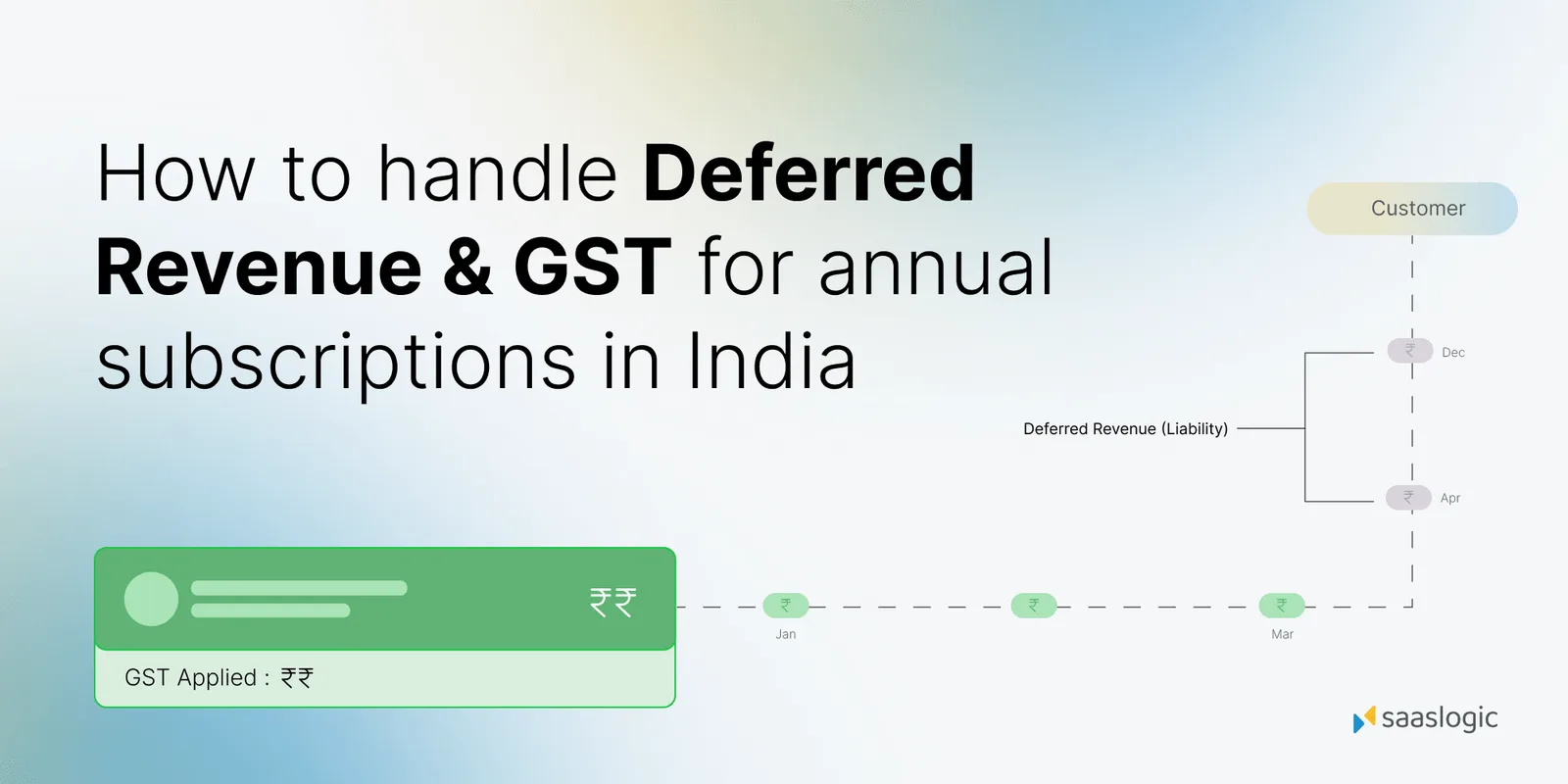
How SaaS Companies in India Handle Deferred Revenue & GST for Annual Subscriptions
G Rejitha
Table of content
- Understanding Deferred Revenue in Subscription Businesses
- Why Deferred Revenue Matters for Annual Subscriptions
- How GST Applies to Subscription-Based Businesses?
- GST on Annual Subscriptions in India
- Difference Between Deferred Revenue & GST Liability
- Common GST Challenges for SaaS & Subscription Companies
- The Role of GST-Compliant Billing Systems
- Best Practices for Managing Deferred Revenue & GST
- Why is Accurate GST Compliance Important for SaaS Companies?
- The Future of AI SaaS Billing in India
Subscription models are quickly growing in India. Many SaaS and digital companies are depending on annual subscriptions for predictable revenue. However, they must also manage deferred revenue & GST compliance carefully.
For annual subscriptions, payment is collected upfront, but the service is delivered over the year. This leads to a difference between payment & earned revenue. Moreover, businesses must also manage GST properly.
Understanding Deferred Revenue in Subscription Businesses
Before discussing taxation, knowing what is deferred revenue in SaaS would be beneficial.
In simple terms, deferred revenue is amount that a firm receives in advance for services that will be delivered in the future. The revenue cannot be recognized immediately as the service is not fully delivered yet.
For example,
A SaaS company sells an annual plan for Rs.12,000. The customer pays at the start of the year, but the service is delivered monthly.
From an accounting perspective, the company cannot record the entire Rs.12000 as revenue immediately. Instead, it recognizes Rs. Rs.1000 per month as the service is delivered. Until then, the remaining amount is noted as deferred revenue in the balance sheet.
This concept is mainly important for SaaS companies. It’s because their business model depends mainly on recurring subscriptions. Managing deferred revenue properly ensures accurate financial reports. Additionally, it tracks real performance.
Why Deferred Revenue Matters for Annual Subscriptions
Annual plans are popular because they improve customer commitment & reduce churn. However, they also make deferred revenue management more complex.
When a customer purchases an annual plan, the company receives a large payment immediately. While this improves cash flow, the revenue must be spread across the service period.
For example, if a company sells 1,000 annual subscriptions worth Rs. 12,000 each, it receives Rs. 1.2 crore instantly. However, accounting rules require the business to identify revenue gradually over 12 months.
This is where deferred revenue becomes critical.
The unearned amount is noted as a liability and recognized as revenue each month. For SaaS companies, this approach helps in:
- Accurate financial reporting
- Clear tracking of recurring revenue
- Better revenue forecasting
- Transparent investor reporting
Without proper deferred revenue management, financial statements may not reflect the actual performance of the business.
How GST Applies to Subscription-Based Businesses?
In India, most SaaS platforms & digital services are usually classified as OIDAR or software services under GST.
Currently, GST on SaaS subscription services is typically charged at 18%. This means businesses must collect GST on subscription fees when they issue invoices to customers. However, the key challenge arises when businesses combine deferred revenue accounting with GST rules.
Revenue is recognized gradually, but GST may need to be paid earlier. Understanding this difference is important to maintaining proper GST compliance.
GST on Annual Subscriptions in India
When customers purchase yearly plans, businesses must find out how to apply GST on annual subscriptions. Under GST regulations, tax reliability is usually triggered when any of the following happens:
- The invoice is issued.
- Payment is received.
For most subscription businesses, both happen at the start of the subscription. Therefore, GST is usually paid when the invoice is issued. Even if revenue is recognized monthly, GST is usually paid upfront.
Difference Between Deferred Revenue & GST Liability
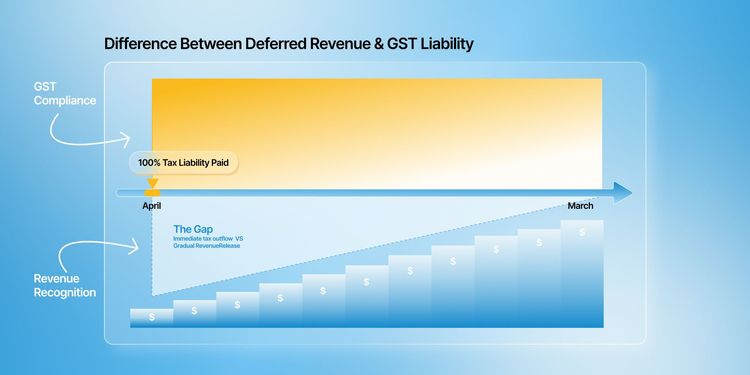
Many entrepreneurs & finance teams initially assume that GST can be paid gradually as revenue is recognized. However, this is not always the situation.
Accounting standards need businesses to consider advance payments as deferred revenue until the service is delivered. However, GST compliance follows tax regulations focusing on the timing of invoices & payments.
This creates a situation where:
- Revenue recognition is spread across months.
- GST payments may be required earlier.
For example,
If a customer pays for a 12-month subscription in April, the GST on annual subscriptions may need to be reported in April’s tax return.
However, the accounting books will show most of that amount as deferred revenue until each month’s service is delivered. This difference is common and completely normal. However, it needs proper tracking to maintain GST compliance.
Common GST Challenges for SaaS & Subscription Companies
Subscription companies in India often face many challenges while managing GST and deferred revenue.
One major issue is incorrect invoicing. The invoice structure with no clarity in the subscription period & tax amount. In this case, it can create confusion during audits & tax filings.
Another common problem occurs when businesses fail to track GST on subscription fees separately from revenue recognition. This can result in incorrect tax reporting.
International SaaS companies selling services in India also need to understand GST on SaaS subscriptions for India, mainly when dealing with cross-border transactions. Without a proper billing system, managing these changes can become difficult.
The Role of GST-Compliant Billing Systems
To manage subscriptions well, businesses need billing systems that support GST and deferred revenue. A reliable GST compliant billing software in India helps companies automate complex subscription workflows. It also works as a GST invoice generator SaaS, automatically calculating GST, generating tax-compliant invoices, & managing recurring billing without manual effort.
These systems also ensure that GST on subscription fees is correctly applied based on location, tax category & service type.
Another major advantage is automated revenue recognition. The system can automatically convert advance payments into deferred revenue. In addition to this, the system also recognizes revenue on a monthly basis. This, in turn, reduces accounting errors and ensures financial reports stay accurate.
If your SaaS company is growing, then investing in GST compliant billing software in India can simplify operations.
Best Practices for Managing Deferred Revenue & GST
Managing both effectively requires a structured financial process.
First of all, companies must clearly separate cash collection, revenue recognition & tax reporting. All of these elements follow different rules & must be tracked separately.
Secondly, finance teams should maintain clear documentation of subscription terms. Every invoice should mention certain key elements to ensure proper GST compliance. The elements are billing period, service period & GST details.
Thirdly, companies should frequently verify that their revenue & tax reports are precise. This makes sure that the amount reported as GST on subscription fees matches the invoices generated during the tax period.
Fourth, companies must stay updated with evolving tax regulations. Since GST rules may change, SaaS companies must review their compliance process regularly.
Automation plays a key role in reducing manual work. Businesses using GST compliant billing software in India can automatically manage several processes. This includes subscription billing, tax calculations & automate deferred revenue accounting.
Why is Accurate GST Compliance Important for SaaS Companies?
Maintaining proper GST compliance is not just about avoiding penalties. It also builds credibility with investors, partners & customers. Inaccurate GST reporting can lead to several problems. The list includes tax notices, interest charges & compliance issues. All these issues can disrupt financial operations & slow business growth.
For fast-growing SaaS businesses, small GST mistakes on annual subscriptions can quickly grow when thousands of customers are involved. Accurate systems and processes help companies stay compliant while concentrating on growth.
The Future of AI SaaS Billing in India
India’s digital economy is expanding quickly. SaaS platforms, AI products, and digital services are becoming key factors to business operations. As subscription businesses grow, managing GST and deferred revenue properly will become even more important.
Companies that build strong billing infrastructure early will find it easier to scale. Automated systems that support GST compliance for SaaS subscriptions in India, as well as recurring billing and revenue recognition, will become essential tools for finance teams.
Using clear accounting practices with modern billing technology would be ideal. Automated GST invoicing helps businesses manage revenue & GST efficiently.
Final Thoughts
Annual subscriptions help businesses generate predictable revenue. But they also bring challenges related to deferred revenue and GST. Companies need to clearly understand how revenue should be recognized and when GST needs to be paid.
By making use of proper processes and GST-compliant billing software in India, companies can manage annual subscription billing smoothly. At the same time, they can maintain accurate financial records.

G Rejitha
Senior Technical Content Writer
G Rejitha is a Senior Technical Content Writer with over 11 years of experience creating clear, engaging, and insight-driven content for the tech industry. With a strong focus on SaaS, AI, cloud, and digital transformation. Rejitha specializes in turning complex technical concepts into easy-to-understand narratives that help businesses connect with their audience. Her work expertise includes SEO-driven web contents, blogs, whitepapers, case studies, product documentation, newsletters, and more. Rejitha delivers content that supports brand credibility, drives engagement, and simplifies technology for decision-makers, product teams, and customers alike.
Related Topics
Categories
- Churn Reduction and Customer Retention
- Pricing Strategies and Revenue Models
- Billing, Payments and Invoicing
- Customization and Enterprise Use Cases
- Growth Scale and Business Strategy
- Subscription Management and Optimization
- Technology and Integrations
- Startups and Marketing
- Trends and Thought Leadership
- SaaS Accounting & Compliance
- Revenue automation
Frequently Asked Questions
While deferred revenue means the income is recognized monthly, GST compliance requires businesses to report GST on subscription fees based on the invoice timing. This often happens at the start of the subscription.